Choosing a Claude Model: Opus, Sonnet, Haiku or Fable
Claude Fable, Opus, Sonnet and Haiku compared on price, context and output length, with a simple way to pick one for chat, coding, agents and bulk jobs.
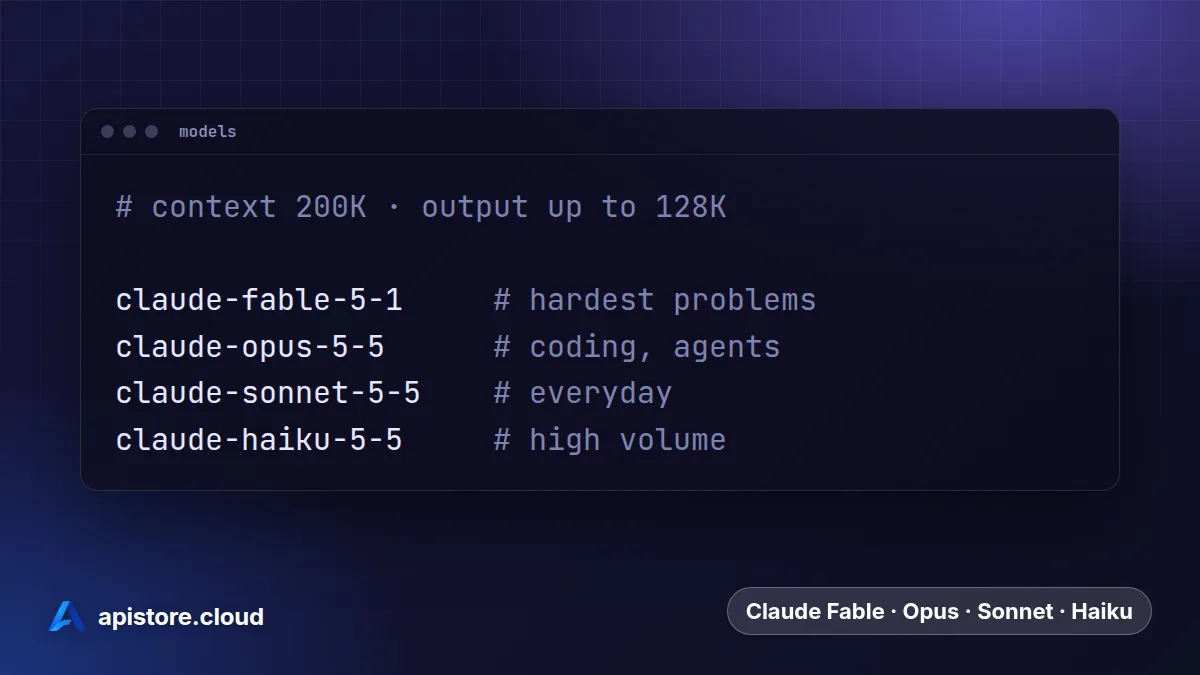
Anthropic sells Claude in tiers. The tiers share an API, a 200,000-token context window and the same features, so you can switch between them by changing the model name. What changes is how much thinking you get for your money. This post sets them side by side and suggests where to start.
The four tiers
| Model | Send as | Input | Cached input | Output |
|---|---|---|---|---|
| Claude Fable 5.1 | claude-fable-5-1 | $7 | $0.175 | $35 |
| Claude Opus 5.5 | claude-opus-5-5 | $2.8 | $0.14 | $14 |
| Claude Sonnet 5.5 | claude-sonnet-5-5 | $1.4 | $0.07 | $7 |
| Claude Haiku 5.5 | claude-haiku-5-5 | $0.07 | $0.007 | $0.35 |
Prices are per million tokens, in US$, and update on this page when the price changes. All four can write up to 128,000 tokens in one answer.
- Fable is the largest tier, for the hardest problems: long chains of reasoning, research, work where a wrong answer is expensive.
- Opus is the strong all-rounder for difficult coding, analysis and agents that run many steps on their own.
- Sonnet is the everyday tier: chat, writing, code review, most product features. It is where most teams start.
- Haiku is the small, fast tier for high volume: classification, extraction, routing, short replies, summaries of many documents.
A simple way to choose
- Start with Sonnet. Build the feature, write a handful of real test inputs, and look at the answers.
- Move down to Haiku if Sonnet's answers are already good and the job is simple or runs at high volume. Run the same test inputs; if they still pass, you keep the saving.
- Move up to Opus if Sonnet makes mistakes you can't fix with a better prompt, or if an agent loses its way on long tasks.
- Use Fable for the few requests where quality matters more than the price, not for everything.
You can mix tiers in one product. A common pattern is a cheap model that sorts incoming requests and a stronger one that answers the hard ones.
Things that change the bill
- Output costs five times input on every tier. A model that writes long answers costs more than one that reads long prompts. Ask for the length you need.
- Thinking is output. With
reasoning_effortset, the tokens Claude spends thinking are billed as output. Uselowfor simple tasks and keephighfor hard ones. - Cached input is much cheaper. When the start of your prompt is the same as a recent request, that part can be read from cache at the cached price. Keep fixed instructions at the start and changing text at the end.
- Haiku 5.5's long prompts. Over 100,000 prompt tokens, a Haiku 5.5 request is billed at its long-prompt prices, shown on its model page. The other tiers have no such step.
Older versions
claude-opus-4-8, claude-sonnet-4-6, claude-haiku-4-5 and other earlier versions are still on sale. Use them when your prompts were tuned on that version and you need answers that don't change. For new work, start with the 5.5 models: Opus 5.5 costs less than Opus 4.8 and Opus 5.
Try before you choose
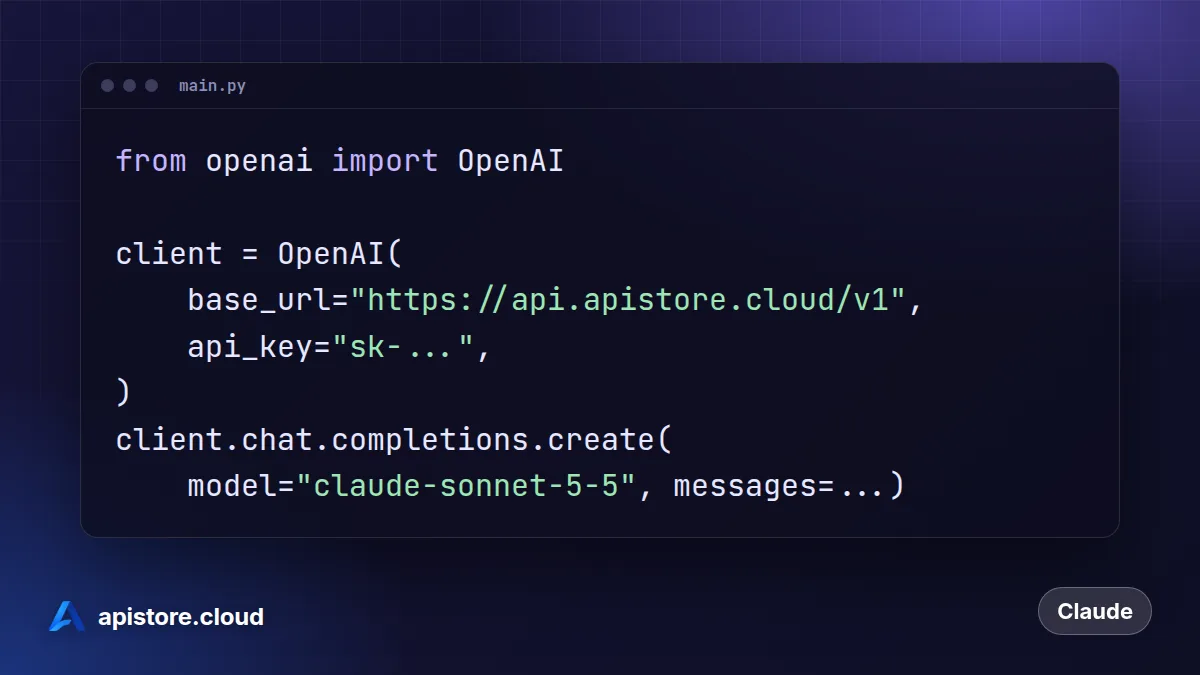
Open the Playground and send the same prompt to two Claude models, one after the other. The Usage page shows what each request cost, so you can compare quality and price on your own text. Call Claude with the OpenAI SDK shows the code.
Also in Tiếng Việt, Español, Português, Bahasa Indonesia